SEO Content Ideas for Contractors Targeting Multiple Service Areas
Elizabeth Palermo
Founder & CEO, Brain Kindle LLC
KEY TAKEAWAYS
- Creating duplicate service pages and just swapping the city name will get your site penalized by Google.
- You need dedicated, unique Service Area Pages for every major city or county you target.
- Highlighting local landmarks, neighborhood specifics, and local reviews makes content unique and relevant.
- Internal linking from educational blog posts to your local landing pages boosts their ranking power.
The short answer
Build one page per town you genuinely work in, and only where you can write several hundred words that could not be copied to any other town. Local projects, local housing stock, local codes and local reviews. If you cannot, the page will not index and it will drag the rest of the site down with it.
If your contracting business operates out of Albany but serves the entire Capital Region—including Troy, Schenectady, and Saratoga Springs—you face a unique local SEO challenge. How do you rank for searches in cities where you don't have a physical address? The answer lies in a structured, scalable content strategy.
Many SEO agencies try to solve this by creating hundreds of thin, duplicate pages where the only difference is the city name. Google hates this and will penalize your site. In this article, we will provide actionable SEO content ideas for contractors targeting multiple service areas so you can expand your reach the right way.
The Difference Between Service Pages and Service Area Pages
Before creating content, you must understand the hierarchy of a multi-location SEO strategy. - Service Pages: These describe WHAT you do (e.g., "Kitchen Remodeling," "Roof Replacement"). They are general and authoritative. - Service Area Pages (Local Landing Pages): These describe WHERE you do it (e.g., "Kitchen Remodeling in Saratoga Springs"). These are the pages designed to capture local search intent.
How to Create Unique Local Content Without Spamming
To rank a Service Area Page, the content must be genuinely useful and hyper-localized. Here are ideas to make each city page unique:
1. Localized Project Portfolios: Feature photos and case studies of actual jobs you completed in that specific city. Write a paragraph explaining the project: "We recently completed a historic roof restoration on a Victorian home near Washington Park in Albany..."
2. City-Specific Reviews: Use a review widget that filters your Google reviews to only show testimonials from customers in that specific town. This builds immense local trust.
3. Local Building Codes and Climate Factors: Discuss how your services apply to the local area. For example, an HVAC contractor might mention specific winterizing needs for homes in upstate New York, or a plumber might discuss common pipe issues in older Troy neighborhoods.
4. Neighborhood References: Naturally weave in mentions of local landmarks, major highways, or distinct neighborhoods to prove to Google (and the user) that you truly know the area.
Supporting Content and Internal Linking
Service area pages should not exist in a vacuum. You need supporting blog content to build topical authority. Write educational articles like "How to Choose a Roofing Contractor in New York" or "Signs Your AC Needs Repair." Within these educational posts, strategically place internal links to your local landing pages.
For example: "If you notice these signs, it's time to call a professional. We offer fast, reliable [AC Repair in Schenectady - link to page] for all residential properties." This internal linking distributes authority and tells Google exactly what your local pages are about.
Prioritizing Your Target Areas
Do not try to build 50 city pages at once. Start with your primary location and your 3 to 5 most profitable surrounding cities. Build deep, high-quality content for those areas first. Once those pages are ranking and generating leads, you can slowly expand your service area content plan to include smaller towns and suburbs.
The test for whether a page should exist
Take the draft and swap every instance of the town name for a different one. If the page still reads as entirely accurate, it is a duplicate with a variable in it and Google will treat it as one.
This single check prevents almost every mistake contractors make with location pages. It is also why the honest answer to "how many location pages should I build" is usually far fewer than an agency will quote.
| Fails the test | Passes the test |
|---|---|
| We provide quality plumbing in Troy | Most of South Troy is pre-1940 with original cast iron stacks |
| Serving Troy and surrounding areas | We work Troy north of Hoosick Street most weeks |
| Our Troy customers love us | Four Troy reviews, shown with the street or neighborhood |
| Fast response times in Troy | Typically on site in Troy within the hour from our Albany base |
Where the local substance comes from
Your own job history
The richest source and the one nobody uses. Pull the last two years of jobs by town. You will have photographs, addresses, dates and what was actually wrong. Three genuine local jobs described properly is more unique content than any amount of research.
The housing stock
This is where Capital Region contractors have an unusual advantage, because the towns genuinely differ. Much of Troy and Albany's older neighborhoods predates modern wiring and plumbing. Clifton Park is heavily post-1970 suburban. Saratoga mixes preserved Victorian housing with new construction.
Those differences produce genuinely different work. Knob and tube replacement is a real Albany conversation and close to irrelevant in a Clifton Park subdivision. Writing about what you actually encounter in each place produces unique pages without any effort to be unique.
Local codes and permitting
Permit processes, inspection requirements and fees differ by municipality, and homeowners genuinely want to know. This is useful information that no competitor's template page contains.
How many pages, and in what order
Start with the three to five towns producing the most work already, not the ones you wish produced work. A page for a town you have never worked in has no photographs, no reviews and no job history, which is exactly why it will be thin.
Publish those, wait three or four weeks, and check whether they indexed. If they did, the model works and you can extend it. If they did not, adding fifteen more will not help, and the problem is either depth or overall site authority.
The gate matters. Most location-page projects fail not because the idea is wrong but because forty pages went live at once, most were thin, and the thin ones taught Google to distrust the pattern.
We build location pages that index, which usually means fewer of them than you were expecting.
BOOK A DEMOLinking them together
Every location page should link up to the relevant service page, across to the two or three neighbouring towns, and down to any blog post specific to that area. The parent service page links back down to each location.
Orphaned location pages are common and fatal. If a page can only be reached from the sitemap, Google reads that as your own assessment of its importance.
Frequently Asked Questions (FAQ)
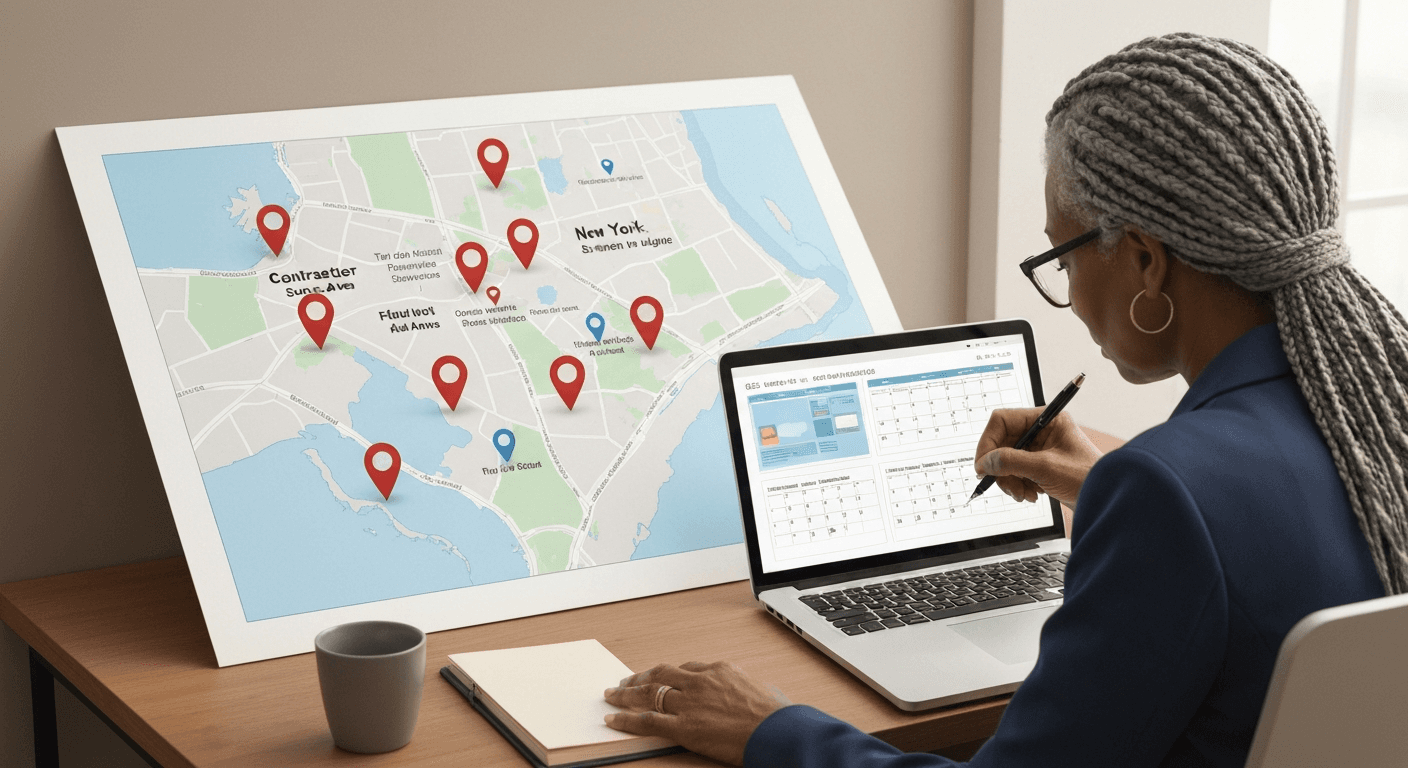
Q: Should I put a map on my service area pages? A: Yes, embedding a Google Map of the specific city or your driving directions to that area helps reinforce local relevance.
Q: Can I use AI to write my location pages? A: You can use AI to outline and draft content, but you must manually edit it to include real, unique local details, project photos, and specific neighborhood references to avoid thin content penalties.
Q: How many location pages is too many? A: However many you can give real local substance to, and no more. For most Capital Region contractors that is between three and ten. The limit is your job history, not your ambition.
Q: Should I build pages for towns I want to expand into? A: Not yet. You have nothing local to say, which guarantees a thin page. Do the work there first, even a handful of jobs, then build the page around what you actually did.
Q: What word count should each page be? A: Aim for several hundred words of genuinely local material, plus whatever shared content is appropriate. Word count is the wrong target. A page that passes the swap test at 600 words beats one that fails it at 1,500.
Q: Do location pages cannibalise my main service pages? A: They can, if the location page is just the service page with a town name added. Keep the service page targeting the service generally and the location page targeting the service in that place, and make sure the local one contains material the general one does not.